
If you’ve ever stared at a hazy, slightly greenish pool and wondered why your chlorine test strip is reading “fine” — you’re not alone. This is one of the most frustrating things about pool ownership, and it’s exactly the situation where shocking your pool is the right move.
Pool shock is one of those things that sounds more complicated than it is. Once you understand what it does and when to use it, it becomes a regular part of keeping your water clear. This guide walks through the whole thing: what shock actually is, which type to use, how much to add, and what to do after you’ve shocked so you don’t undo your work.
What Pool Shock Actually Does
Regular chlorine sanitizes your pool by killing bacteria and controlling algae. But over time, chlorine reacts with contaminants — sunscreen, sweat, urine, body oils — and forms compounds called chloramines. These are what cause that harsh “chlorine smell” (ironic, since it means your chlorine is used up, not that there’s too much of it).
Chloramines are largely ineffective as sanitizers. They sit in your water, irritate swimmers’ eyes, and give you a false reading on basic chlorine test strips. The strip says there’s chlorine present — technically true — but it’s the wrong kind.
Shocking raises your free chlorine to a high enough concentration (typically 10–30 ppm) to break apart chloramines and restore your pool’s active sanitizer. It’s sometimes called “super-chlorination” for this reason.
You should shock your pool when:
- The water looks hazy or slightly green even though chlorine tests okay
- There’s a strong chlorine smell (classic sign of chloramines)
- After a heavy rain or a pool party with lots of swimmers
- You can see or suspect early algae growth
- You’re opening the pool for the season
- Weekly as a preventive measure during peak summer
Types of Pool Shock
Not all pool shock is the same product. There are three main types, and picking the right one matters.
Calcium Hypochlorite (Cal-Hypo)
This is the most common and most powerful. Cal-hypo is typically 65–78% available chlorine and works fast. It’s the right choice for treating algae or restoring a badly neglected pool. Downside: it adds calcium to your water, so if you already have hard water, use it carefully. It also needs to be pre-dissolved in a bucket before adding to the pool — never pour it directly into the skimmer.
Dichlor (Sodium Dichloro-s-Triazinetrione)
Dichlor dissolves quickly and is gentler on pH. It also contains stabilizer (CYA), so it’s a good choice for pools that are already well-maintained and don’t have a CYA problem. Not ideal if your CYA is already on the high side — you don’t want to push it further.
Non-Chlorine Shock (Potassium Peroxymonosulfate)
This one doesn’t actually add chlorine — it oxidizes contaminants and breaks up chloramines without raising free chlorine. Useful when you want swimmers back in the water within 15 minutes and your chlorine levels are already fine. Not effective against algae.
Guessing on shock dosage leads to wasted product or an under-treated pool. The free Pool Chemical Calculator app calculates precise shock doses based on your pool size, current chlorine level, and water temperature — no math required. Works on iPhone and Android.
How Much Shock to Use
Standard pool shock dosage with cal-hypo (68% available chlorine) is roughly 1 lb per 10,000 gallons for routine maintenance shocking. For algae treatment, double or triple that — 2–3 lbs per 10,000 gallons.
For break-point chlorination (the level where chloramines are actually destroyed), you need to raise free chlorine to about 10x your combined chlorine reading. If your test shows 0.5 ppm combined chlorine, you need to hit 5 ppm free chlorine minimum to break through.
The exact amount varies by your pool volume, current chlorine level, water temperature, and the type of shock you’re using. This is where a calculator saves you from both under-dosing (not enough to actually fix anything) and over-dosing (wasting money and potentially bleaching your vinyl liner).
Step-by-Step: How to Shock Your Pool
- Test your water first. Know your current free chlorine, pH, and alkalinity before adding anything. Shock works best when pH is between 7.2–7.4. High pH significantly reduces chlorine effectiveness.
- Shock at dusk or night. UV sunlight destroys chlorine fast. If you shock in the afternoon sun, you can lose a significant portion before it does its job. Evening is ideal.
- Pre-dissolve cal-hypo if using it. Fill a 5-gallon bucket with pool water, then slowly add the shock while stirring. Never the reverse — adding water to concentrated shock can cause a violent reaction. Never pour granular cal-hypo directly into the skimmer.
- Add shock near return jets with the pump running. Pour around the perimeter of the pool, not in one spot. Keep the pump running for at least 8 hours to circulate the treatment.
- Stay out of the pool. Wait until free chlorine drops back below 3–4 ppm before swimming. This typically takes 8–24 hours depending on sun exposure and how heavily you dosed.
- Retest in the morning. Check chlorine levels before anyone gets in. If the water is still hazy, you may need a second round.
Common Mistakes That Cancel Out Your Shock
Shocking is pretty forgiving, but a few mistakes will neutralize your effort entirely:
- Wrong pH first. If your pH is above 7.6 when you shock, much of the chlorine goes to waste. Fix pH before shocking.
- Shocking during peak sun. Chlorine without stabilizer (like cal-hypo) gets destroyed by UV rapidly. Shock after sunset.
- Not running the pump long enough. Shock won’t distribute itself. Keep circulation going the whole night.
- Not addressing the cause. If algae is growing because your CYA is too high and your chlorine can’t work, shocking without fixing the underlying chemistry is a short-term fix at best.
What to Expect After Shocking
If you shocked for cloudiness or early algae, the water should clear within 24–48 hours. Dead algae turns the water a milky white-grey — this is normal. Run your filter continuously and backwash or clean it when pressure rises. The filter is doing heavy lifting right now.
If the water is still green after 24 hours, test your chlorine. If it’s dropped to near zero, you’ve got active algae consuming it. You’ll need to shock again, possibly at a heavier dose, and check whether your CYA level is too high to let chlorine work effectively.
Bright-green water that turns teal-blue after shocking is typical of severe algae. Keep the pump running, add a clarifier or floc if needed, and give it 48–72 hours.
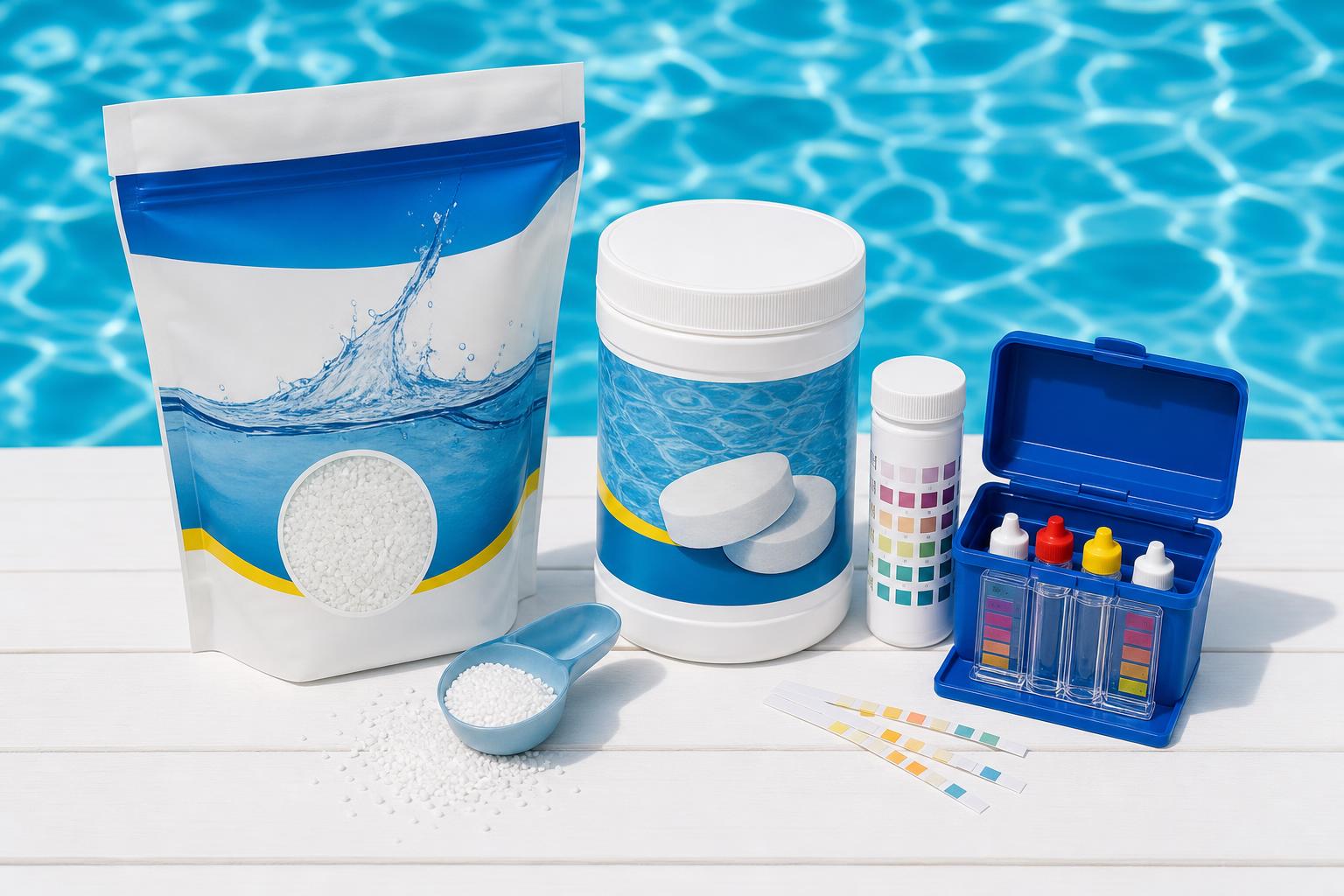
Clean Water Pools may earn from qualifying Amazon purchases.
Frequently Asked Questions
Can I shock a pool that has a vinyl liner?
Yes, but pre-dissolve granular shock in a bucket first and pour it around the edges while the pump is running. Never let undissolved shock granules sit on a vinyl liner — they can bleach or damage the material. Liquid shock or dichlor (which dissolves easily) is gentler on liners.
How often should I shock my pool?
Once a week during peak swimming season is a common recommendation for heavy-use pools. Light-use pools may only need it every 2–4 weeks. Always shock after a party, heavy rain, or any time you see cloudy water or smell chloramines.
Why is my pool still green after shocking?
The most common reason is that the shock didn’t reach break-point chlorination — either the dose was too low or your pH was too high when you added it. Check your pH first (target 7.2–7.4), then shock again at a higher dose. Also verify your CYA isn’t above 80 ppm, which heavily reduces chlorine effectiveness.
Can I swim in a pool that smells like chlorine after shocking?
Wait until free chlorine is below 3–4 ppm regardless of smell. Test with a kit, not just a strip — strips can be inaccurate at high concentrations. The smell indicates chloramines are being broken down, which is the shock working correctly.
What’s the difference between shock and regular chlorine?
Regular chlorine (tablets, liquid) maintains a steady low-level sanitizer residual. Shock is a high-dose treatment designed to oxidize contaminants and restore water clarity. You need both: regular chlorine for daily maintenance, shock for periodic reset and problem treatment.
Whether you’re shocking after a party or doing weekly maintenance, the Pool Chemical Calculator app gives you exact dosing for chlorine, shock, pH, alkalinity, calcium, and more — free on iOS and Android. Visit poolchemicalcalculator.com to learn more.


