If your pool keeps eating chlorine no matter how much you add, the problem might not be what you’re adding — it might be what’s missing. Pool stabilizer, also called cyanuric acid or CYA, is one of the most misunderstood chemicals in pool care, and getting it wrong costs you money and headaches all season long.
Here’s a no-nonsense breakdown of how CYA works, what levels to target, and how to fix it when things go sideways.
What Pool Stabilizer Actually Does
Chlorine is incredibly effective at killing bacteria and algae — but it’s also extremely sensitive to sunlight. UV rays can destroy up to 90% of your free chlorine in just two hours on a bright summer day. That’s not a typo.
Cyanuric acid acts as a shield. It bonds loosely with chlorine molecules, protecting them from UV degradation while still allowing the chlorine to sanitize your water. Think of it as sunscreen for your chlorine.
Without stabilizer, maintaining chlorine levels in an outdoor pool on a sunny day is almost impossible without constant re-dosing. With the right CYA level, your chlorine lasts dramatically longer and your chemical costs drop significantly.
Ideal CYA Levels
The target range depends on your pool type:
- Outdoor chlorine pools: 30–50 ppm (parts per million)
- Saltwater pools: 60–80 ppm (salt chlorinators need more protection since they produce lower chlorine concentrations)
- Indoor pools: 0–30 ppm (no UV exposure, so you need very little)
- Pools with chlorine tablets (trichlor): Watch CYA closely — trichlor tablets already contain CYA and will raise levels over the season
Below 30 ppm, you’re losing chlorine to the sun faster than it makes sense. Above 80–100 ppm, you run into “chlorine lock” — a state where chlorine becomes less effective even when test results show adequate levels.
Stop guessing on stabilizer amounts. The Pool Chemical Calculator tells you exactly how much cyanuric acid to add based on your pool’s volume and current CYA reading — no manual math required.
📲 Download for iOS (App Store) | 🤖 Download for Android (Google Play)
How to Test Your CYA Level
Standard test strips don’t measure CYA well — they’re often inaccurate at the ranges that matter. Use one of these instead:
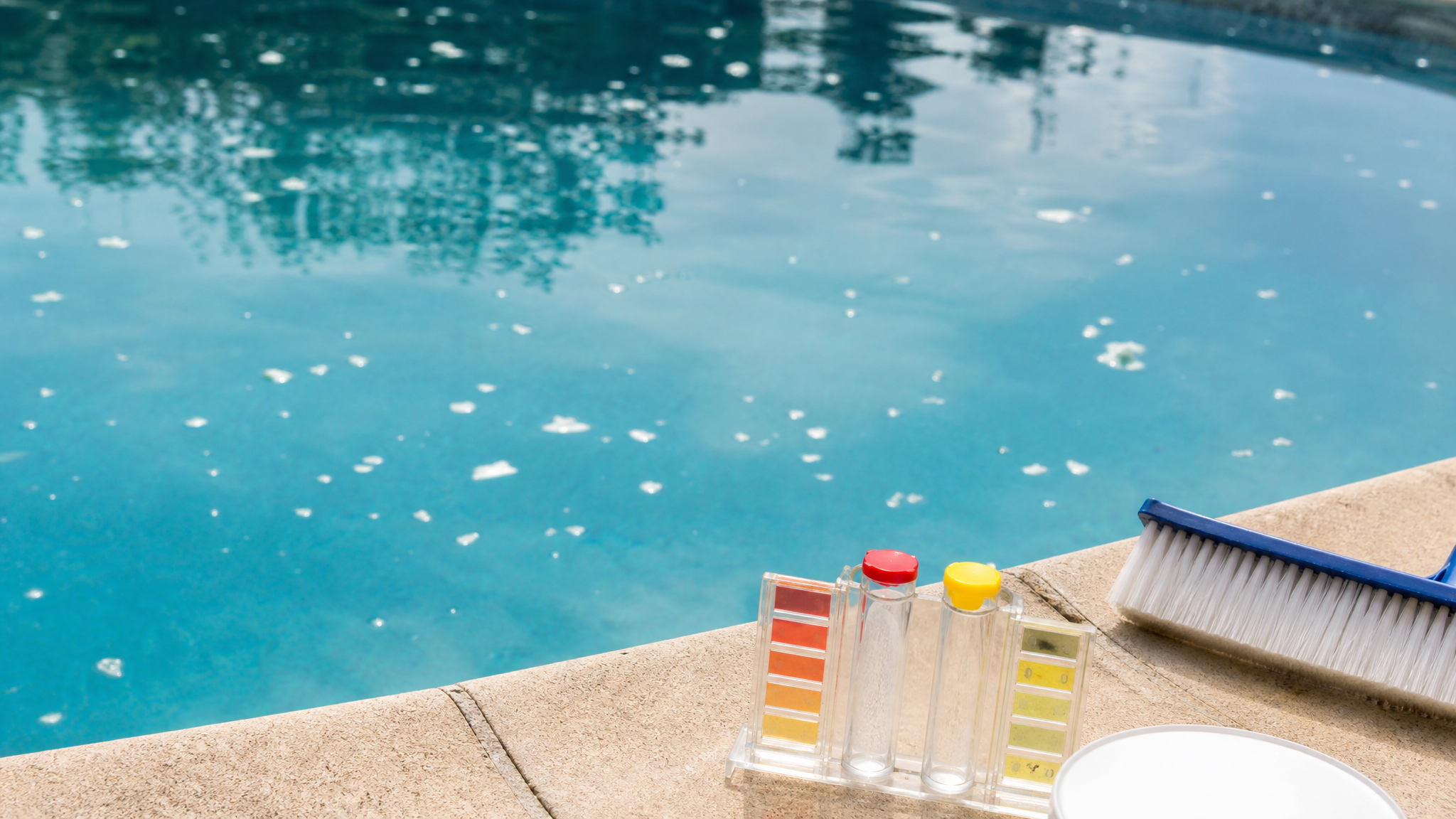
- Turbidity test kit: You add reagent to a water sample in a tube and look through it until a black dot disappears. The measurement corresponds to CYA level. It’s surprisingly accurate.
- Taylor K-2006 or similar drop test kit: More precise, especially for commercial-grade testing
- Digital or photometer testers: Most accurate, used by pool pros
Test CYA at the start of the season and once a month during summer. If you’re adding a lot of trichlor tablets, test more frequently — CYA creeps up slowly and you can hit 100+ ppm by August without realizing it.
How to Add Stabilizer (Cyanuric Acid)
Cyanuric acid comes as a granular powder or liquid. A few important notes:
- Never add it directly through the skimmer if you have a cartridge filter — it can damage the element
- Mix granular CYA in a bucket of warm water first, then pour it slowly around the pool edges near a return jet
- It takes 24–48 hours to fully dissolve and register on tests. Don’t retest immediately.
- Run the pump continuously for at least a day after adding
For a typical 15,000-gallon pool starting at zero CYA, you’ll need roughly 4–5 pounds of granular cyanuric acid to reach 30 ppm. The exact amount depends on your pool size and current level — always calculate before dumping in chemicals.
Chlorine Lock: What Happens When CYA Gets Too High
This is where a lot of pool owners get confused. If CYA climbs above 80–100 ppm, your chlorine becomes “locked” — the stabilizer holds onto the chlorine so tightly that it can’t effectively sanitize. You’ll test and show 3–5 ppm free chlorine, but your pool will still look dull, and algae can take hold.
Signs of over-stabilization:
- Persistent cloudy or dull water even with chlorine present
- Algae starting to grow despite adequate chlorine readings
- Chlorine demand seems unusually high
- CYA test over 80 ppm
The fix? Unfortunately, there’s no chemical that lowers CYA. The only solution is a partial drain-and-refill. Drain 25–33% of your pool water and refill with fresh water. Retest and repeat if necessary. It’s inconvenient, but it’s the only reliable method.
This is why water balance matters so much — calculating exact doses before adding chemicals prevents overshoot in the first place.
CYA and Shock
When you shock a pool, the shock dose needs to account for your CYA level. Higher CYA means you need more chlorine to reach the “breakpoint” concentration that actually kills algae and destroys combined chlorine.
A general rule: your shock treatment should bring free chlorine to at least 10x your CYA level for a brief period to be effective. At 40 ppm CYA, you’re aiming for a 40 ppm chlorine spike during treatment. This is why CYA management matters all season, not just at the start.
Clean Water Pools may earn from qualifying Amazon purchases.
Frequently Asked Questions
How often should I add stabilizer to my pool?
Most pools only need stabilizer added once per season — at opening — unless you’re replacing a lot of water during the year. Cyanuric acid doesn’t evaporate, so it only leaves the pool when you drain water. The exception is if you switch from using trichlor tablets (which contain CYA) to liquid chlorine or cal-hypo, in which case CYA will naturally decline after a water change.
Is pool stabilizer the same as conditioner?
Yes. Cyanuric acid, pool stabilizer, and pool conditioner are all the same chemical (isocyanuric acid). They’re just marketed under different names. Check the ingredient label — they all say “cyanuric acid” as the active ingredient.
Can I have too little CYA in my pool?
Absolutely. Pools with no CYA or very low CYA (under 20 ppm) will burn through chlorine extremely fast in summer sun. You’ll constantly be adding chlorine and never getting ahead of it. This is one of the most common causes of ongoing algae problems and high chemical bills.
My CYA is at 90 ppm — should I worry?
At 90 ppm you’re in the warning zone. Your chlorine’s effectiveness is reduced, and you’ll need to maintain higher free chlorine levels to compensate. If your pool is still clear and balanced, monitor it closely. If water quality is degrading, do a partial drain-and-refill to bring it down to 50–60 ppm range.
Does rain affect CYA levels?
Rain dilutes all your pool chemicals, including CYA. After a heavy rain that significantly raised your water level, you may need to partially drain the pool and retest all your levels. CYA is usually the last thing to worry about after rain — pH and alkalinity shift faster — but heavy or repeated rainfall can gradually drop your CYA below effective range.
Use the free Pool Chemical Calculator to get precise dosing for stabilizer, chlorine, pH, alkalinity, and more — just enter your pool size and current readings, and it does the math for you.